
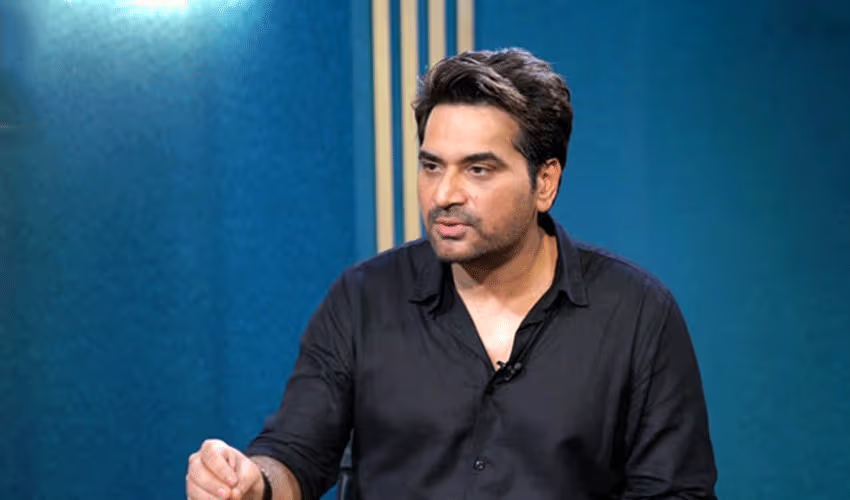
Pakistani actor and producer Humayun Saeed has urged the government to take practical steps towards developing a local over-the-top (OTT) streaming platform, saying a homegrown service could help Pakistani dramas and films reach international audiences and attract the attention of global streaming companies such as Netflix.
In an interview with Ali Salman, Saeed discussed the distinctive identity of Pakistani television dramas, the challenges facing the country’s digital entertainment sector and the need for greater government support. He also shared his views on how social media is creating opportunities for emerging actors and reflected on the professional lessons he learned while working on Netflix’s The Crown.
Humayun Saeed Says Pakistani Dramas Have a Distinct Identity
Discussing the possibility of Pakistani dramas becoming more widely available on international streaming platforms, Saeed explained that local productions have their own style, shaped by storytelling, dialogue delivery and the Urdu language.
He said Pakistani dramas should be recognised for their existing strengths rather than being expected to follow the same approach as international productions.
“Our dramas have a specific style. The writing also has its own style. When we deliver our lines, there is a way of speaking because of the way our Urdu is delivered,” he said.
Saeed acknowledged that international OTT productions sometimes adopt a different and more edgy storytelling approach. However, he maintained that Pakistani dramas already have an identity that could appeal to audiences beyond the country.
He also suggested that political considerations might influence Netflix’s approach to Pakistan, while admitting that he was uncertain when local productions might become available on the platform.
Actor Calls for a Homegrown Pakistani OTT Platform
Rather than depending entirely on international streaming services, Saeed believes Pakistan should first establish its own digital platform to give local filmmakers, producers and actors more opportunities to showcase their work.
“Where there will be a platform, things will be made. Pakistani OTT will be made and once people show their work, then there will be Netflix,” he said, pointing to India’s experience with domestic streaming services.
The actor also called on the government to give greater importance to the entertainment industry and support its development.
“I think the government should do something about it and give importance to it,” he said.
A local OTT platform could potentially provide another distribution channel for Pakistani films, television dramas and original digital productions. It could also create opportunities for emerging talent and help producers explore content designed for audiences with different viewing preferences.
However, the success of such a platform would depend on factors including investment, production quality, distribution, audience demand and a sustainable business model. Saeed’s comments highlight the industry’s interest in developing stronger local infrastructure rather than relying exclusively on overseas services.
Humayun Saeed Discusses Social Media’s Role in Discovering Talent
Saeed also spoke about how social media has changed the way aspiring actors can attract attention from the entertainment industry. In the past, newcomers often depended on auditions, meetings with directors and professional connections to secure opportunities.
Platforms such as TikTok now allow performers to showcase their abilities directly to large audiences. However, Saeed noted that popularity in short online videos does not necessarily demonstrate the skills required for scripted dramas and films.
He cited actress Hania Aamir as an example, recalling that he first noticed her through Dubsmash before she was cast in a drama.
“The thing is that even I saw Hania on Dubsmash and then we took her in a drama so there is potential,” he said.
Saeed explained that acting in short social media clips differs from performing complete scenes and delivering scripted dialogue. While online platforms can help newcomers gain visibility, their ability to handle professional acting roles must also be assessed.
The producer also recalled his own entry into show business, explaining that he had been helping manage factories belonging to Nadeem Ahmad. After enjoying a celebratory show organised by Saeed, Ahmad encouraged him to attend an audition, which eventually led to a drama role.
Lessons From Netflix’s ‘The Crown’
Reflecting on his experience portraying Dr Hasnat Khan in Netflix’s The Crown, Saeed highlighted the importance of discipline, preparation and organisation in professional productions.
He described how the international production maintained structured arrangements for transport, makeup, meals and shooting schedules, ensuring that cast members knew when they were expected on set.
Saeed also praised co-star Elizabeth Debicki for her focus and commitment to her work. He contrasted the production’s organised approach with what he described as less structured routines in parts of Pakistan’s entertainment industry.
“We here are not as organised as producers here, so it would take time for actors to be as well,” he said.
His observations pointed to the potential value of improved planning and professional working practices for Pakistan’s film and television sector, particularly as local productions seek wider international recognition.
‘I Do Not See Myself as a Star’
Despite his successful career as an actor and producer, Saeed said he does not consider himself a star and instead views acting as his profession.
“I do not see myself as a star. This is just my work. You are not a star for doing it. I think Fahad Mustafa and Fawad Khan must be stars,” he said.
He also spoke about his preference for working in his own way, his interest in producing projects and his relatively small social circle.
Saeed’s recent film credits include Love Guru (2025), a romantic comedy directed by Nadeem Baig and co-starring Mahira Khan. He also appeared in the television drama Main Manto Nahi Hoon in 2025.
The Jawani Phir Nahi Ani franchise remains among his best-known film projects, with a third instalment reportedly in development.
His latest comments have renewed attention on the future of Pakistan’s OTT industry, with the actor emphasising the need for local investment, government support and opportunities for homegrown talent to reach audiences around the world.