
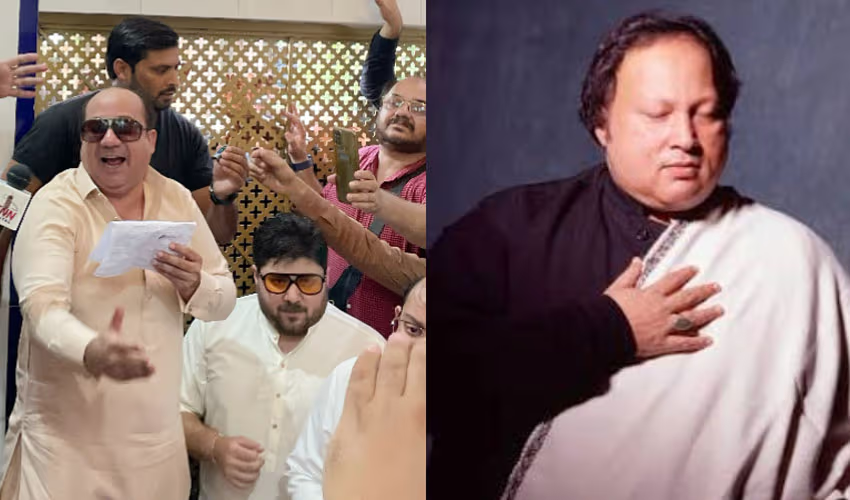
Pakistani singer Rahat Fateh Ali Khan has faced criticism on social media after performing a qawwali at the grave of legendary qawwali maestro Nusrat Fateh Ali Khan on his death anniversary.
Rahat, accompanied by his son Shahzaman Ali Khan, visited Nusrat’s mazar to pay tribute to the late singer, who died nearly three decades ago. During the visit, the father-son duo performed a kalam at the grave site in front of a large gathering.
Videos from the occasion quickly circulated across social media, showing Rahat and his son performing while currency notes were thrown into the air by people attending the gathering.
The scenes prompted mixed reactions online. While some viewers viewed the performance as a musical tribute to one of Pakistan’s most celebrated qawwali artists, others questioned whether performing at the grave site was an appropriate way to commemorate Nusrat.
Several social media users expressed strong disapproval of the manner in which the tribute was conducted. One user questioned the level of respect shown at the grave, while another criticized Rahat over the performance.
Another reaction expressed religious disapproval of the scenes, reflecting the debate that emerged online after the videos became widely circulated.
The criticism has focused largely on the setting and atmosphere of the performance rather than Rahat’s connection to Nusrat. The viral footage has sparked a broader discussion among fans about appropriate ways to honor a respected religious and musical figure.
Rahat Fateh Ali Khan has a particularly close connection to Nusrat Fateh Ali Khan’s musical legacy. He worked alongside his uncle during the early stages of his career and learned from one of the most influential figures in the history of modern qawwali.
Over the years, Rahat developed his own successful career and became one of Pakistan’s best-known qawwali and playback singers. His work has helped introduce the family’s musical tradition to audiences in Pakistan and internationally.
Nusrat Fateh Ali Khan remains one of the most influential qawwali singers in South Asian music. His powerful voice and distinctive style earned him international recognition, and his recordings continue to attract listeners around the world.
Nusrat died in August 1997 at the age of 48, leaving behind a musical legacy that continues to influence singers and musicians.
Rahat’s visit to his uncle’s grave on the death anniversary reflects the continuing connection between the two generations of the Fateh Ali Khan family. However, the performance has also shown how public tributes involving religious or cultural sites can generate differing opinions.
The viral videos have now prompted an online debate about whether the performance was an appropriate tribute and how Nusrat’s legacy should be commemorated.
Despite the criticism, Rahat remains an important figure in the continuation of the family’s qawwali tradition, while Nusrat Fateh Ali Khan’s music continues to hold a lasting place in Pakistan’s cultural history.