
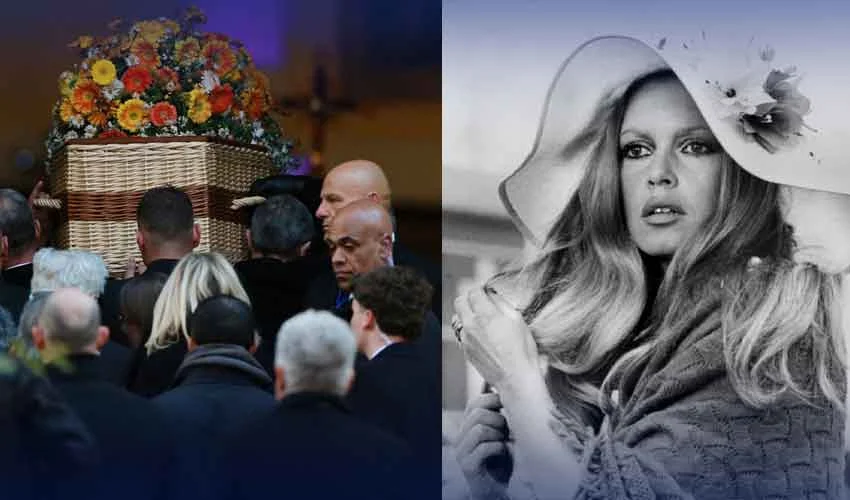
Hundreds gathered in the French Riviera town of Saint-Tropez on Wednesday to pay their respects at the funeral of Brigitte Bardot, the legendary French actress and animal rights activist, who passed away last month at the age of 91.
Bardot’s coffin, adorned with orange and yellow flowers, was brought into Saint-Tropez’s Notre-Dame-de-l’Assomption church for the service, which was broadcast live on French news channels. Inside the church, a black-and-white photograph of Bardot hugging a baby seal was displayed with the words “Merci Brigitte” (Thank you Brigitte). Outside, a man held a placard reading, “The animals thank Brigitte Bardot,” reflecting her lifelong dedication to animal welfare.
Bardot rose to international fame in her early 20s with And God Created Woman, captivating audiences with her tousled hair, fierce energy, and defining a liberated femininity in 1950s France. Beyond her acting career, she became a tireless advocate for animal rights, though her outspoken political views—supporting France’s far-right National Front and making controversial remarks on immigration, Islam, and homosexuality—sparked multiple convictions for inciting racial hatred.
Attendees at the funeral included far-right leader Marine Le Pen and Aurore Bergé, France’s minister for equality and an animal rights advocate, representing the government. Singer Mireille Mathieu, 79, who performed at the service, described Bardot as “France” and “the most beautiful woman in the world,” praising her boldness and independence.
After the funeral, Bardot will be buried privately in a cemetery in Saint-Tropez, the town where she spent much of her later life surrounded by her menagerie of cats, dogs, and horses. A public tribute for fans and locals will later take place at the Pré des Pêcheurs area in La Ponche, the historic old quarter of Saint-Tropez.
Known affectionately as BB, Bardot’s legacy extends beyond her iconic roles. She was the first celebrity to model for a bust of Marianne, the traditional symbol of the French Republic, and became a symbol of cultural change in postwar France. After retiring from cinema in 1973, she devoted herself to animal welfare, leaving an indelible mark on both French culture and global activism.